
Follow the Effects / Research & Writing / Proposal
One site, one decision
A proposed structure for a reviewed infill brief, used to test how evidence could support a next decision.
Fictional method demonstration
- Date / period
- 2026
- Place
- Fictional example
- Contribution
- Adam Scott, proposed research method.
This is a method demonstration, not an analysis of a live client parcel. Start by naming the decision and the person responsible for it, then bound the site and the question.
Separate recorded facts, dated observations, interpretations and missing evidence. A context map should show relationships that matter to the question, rather than accumulating every available layer.
Finish with the next questions, who can answer them, and what would change the recommendation. Any design, title, environmental or financial determination belongs with an appropriately qualified reviewer.
The demonstration does not establish customer demand, a validated fee or time saved. Its value is a clear structure that can be challenged in a consented future test.
This historical demonstration reflects the September 24 predevelopment experiment. The September 27 Living Ground direction broadens the inquiry to neighborhood stewardship; this example remains one possible capability, not the whole proposed product.
Select an image to enlarge it in a new tab.
The demonstration brief
The original page keeps the fictional inputs and limits alongside its working conclusion.
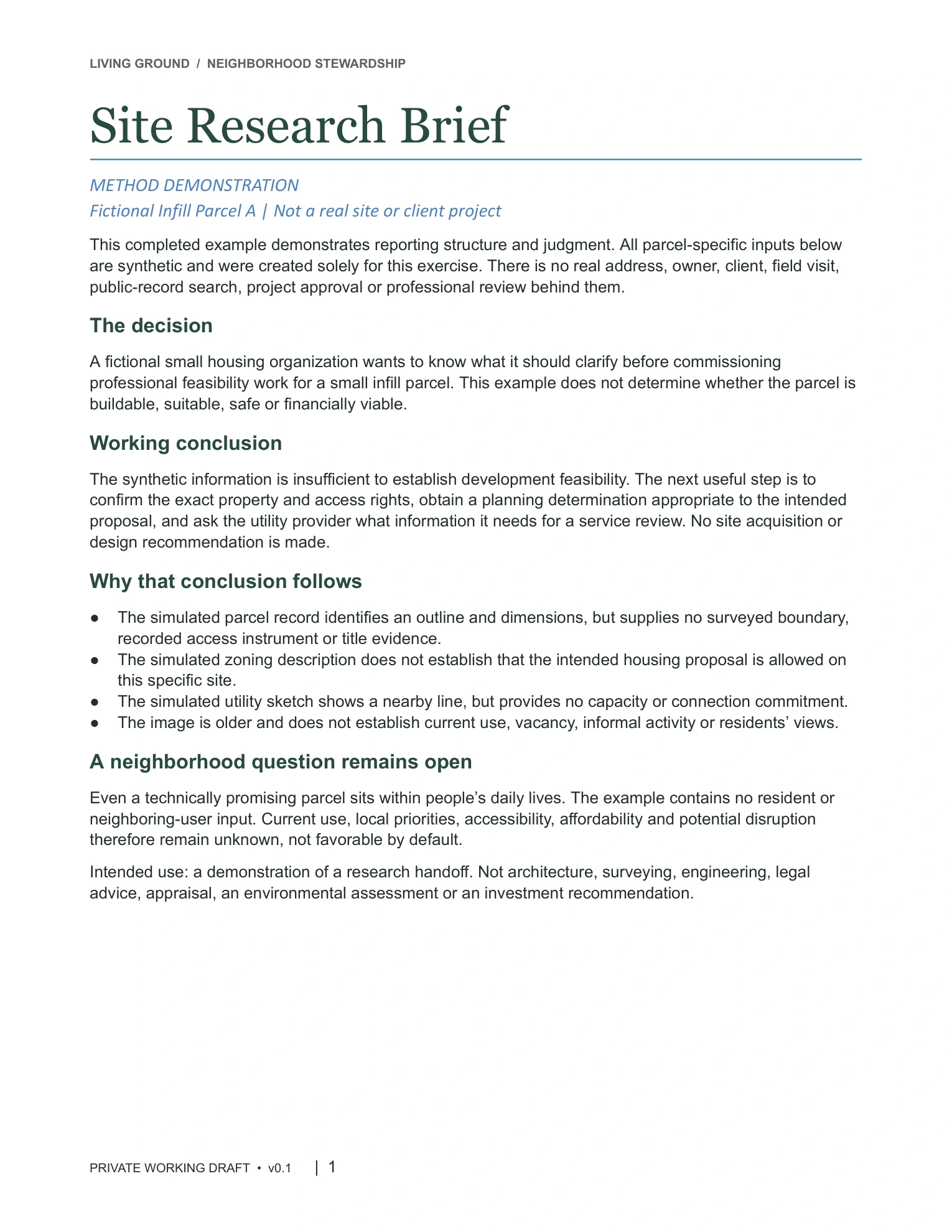
Page 1 of the fictional Site Research Brief, v0.1. Synthetic inputs demonstrate how an unresolved question can lead to a bounded next step; no real parcel, client or feasibility finding is represented.
Adam Scott, fictional website demonstration of an earlier research method. No private prospect or parcel details included.